
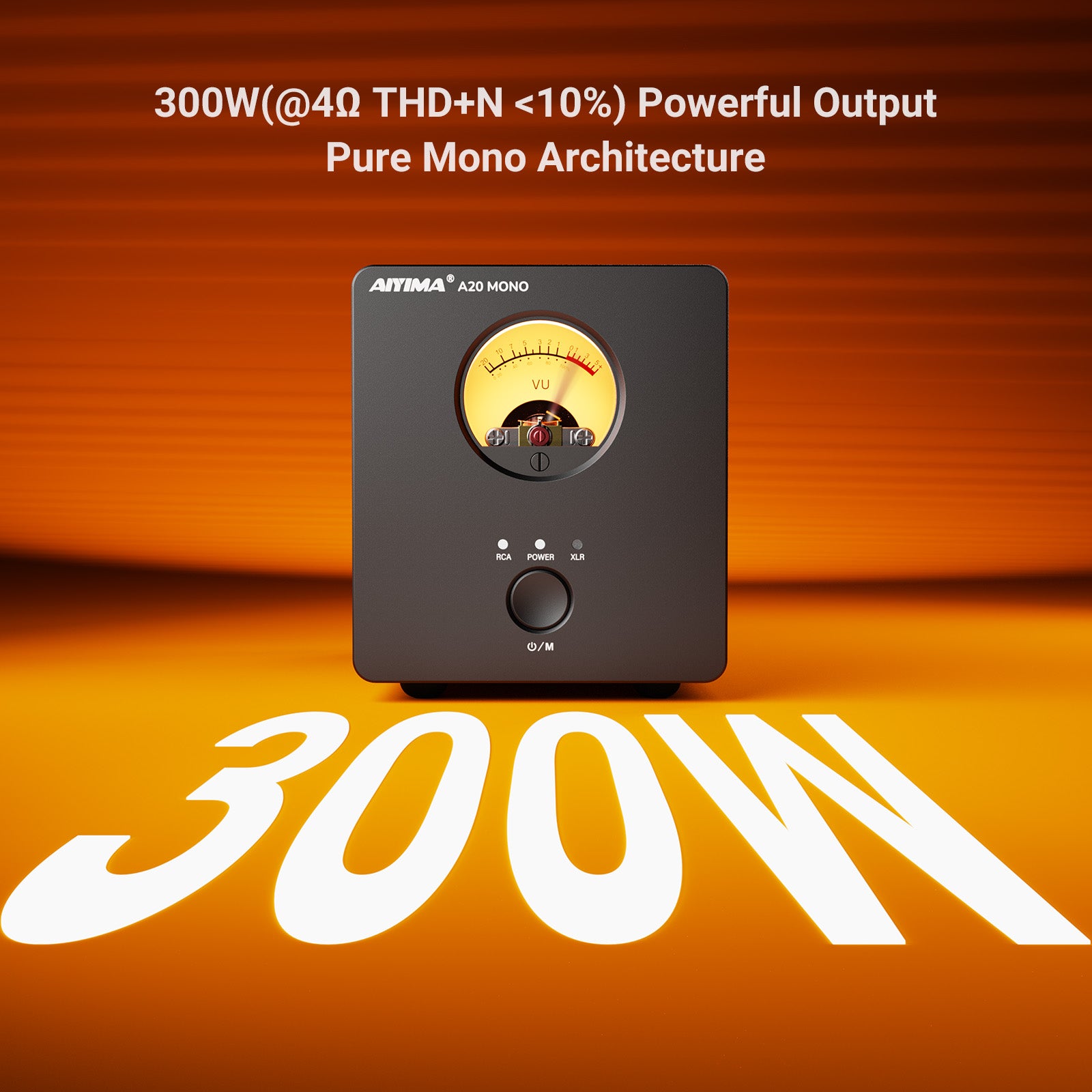
The new AIYIMA A20 MONO may look like just another compact Class-D amplifier — but its latest dyno results tell a very different story. In independent testing by Williston Audio Labs, this tiny $150 monoblock didn’t just meet its advertised power targets; it blew straight past them, peaking at an astonishing 417 watts of dynamic power into 2 ohms.
Yes — 417 watts from a miniature desktop amplifier costing about $150.
Watch the dyno test
A serious monoblock in a tiny package
The AIYIMA A20 MONO is a true single-channel power amplifier built around Texas Instruments’ proven TPA3255 Class-D chip. Its compact all-metal chassis pairs modern amplifier tech with a distinctly retro look — including a large illuminated VU meter. The feature list punches well above the price:
- Fully balanced XLR input
- RCA input
- PFFB implementation
- Vintage-style VU meter
- 12V trigger
- Gain control
- High-pass filter
- Subwoofer output
- Compact all-metal chassis
At roughly $149.99 per unit, a complete dual-mono stereo setup lands around $300. But the real story is what happened when Williston Audio Labs connected it to a professional SMD amplifier dynamometer.
AIYIMA A20 MONO dyno results
8 ohms — rated at 100 watts
| Certified to 1% THD | 109 watts |
| Uncertified to clipping | 130 watts |
| Dynamic power | 124 watts |
At the impedance used by many traditional home loudspeakers, the AIYIMA delivered more power than promised.
4 ohms — rated at 200 watts
| Certified to 1% THD | 204 watts |
| Uncertified to clipping | 237 watts |
| Dynamic power | 235 watts |
The certified result reached 204 watts, slightly exceeding the amplifier’s stated 200-watt target. For a $150 monoblock small enough for a desktop, that is serious output.
2.67 ohms — nearly 333 watts
| Certified to 1% THD | 280 watts |
| Uncertified to clipping | 327 watts |
| Dynamic power | 333 watts |
More than three times its 8-ohm certified output — and Williston Audio Labs did not stop there.
The crazy 2-ohm test
A 2-ohm load sits outside the normal 4–8-ohm territory most buyers will use. It is an extreme stress test, not an everyday recommendation. The AIYIMA survived without smoke, shutdown drama or an explosive ending:
| Certified to 1% THD | 345 watts |
| Uncertified to clipping | 374 watts |
| Dynamic peak power | 417 watts |
That 417-watt figure is dynamic peak power, not continuous clean RMS output. Even with that distinction, it is extraordinary for the size and price. The most meaningful number may be the certified 345 watts at no more than 1% distortion into 2 ohms.
Why these results matter
Cheap mini amplifiers often arrive with spectacular power claims that collapse under independent testing — brief peaks, very high distortion, or lab conditions far from real use. The AIYIMA A20 MONO appears to be different. In Williston Audio Labs’ testing it reached or exceeded its 8-ohm and 4-ohm power targets while showing an unexpectedly large amount of low-impedance headroom. Power testing alone cannot measure imaging, tonal balance, noise or long-term thermal behaviour — but it proves this tiny amp is not merely relying on an inflated number printed on a product page.
Could two A20 MONOs replace a traditional power amplifier?
For about $300 a pair, two A20 MONOs could build a compact dual-mono stereo system with:
- One dedicated amplifier and power supply per speaker
- Balanced XLR connectivity
- More than 100 watts per channel into 8 ohms
- More than 200 watts per channel into 4 ohms
- 12V trigger integration
- Subwoofer-friendly system features
- A much smaller footprint than most traditional power amplifiers
That makes the A20 MONO attractive for demanding bookshelf speakers, tower speakers, compact separates and multi-amplifier home-theatre installs. Match it carefully to your speakers, and don’t treat the extreme 2-ohm test as a normal operating recommendation.
The bottom line
The AIYIMA A20 MONO may be one of the most exciting budget amplifiers of the year. It delivered 109 watts into 8 ohms, 204 watts into 4 ohms and an incredible 345 certified watts into 2 ohms, with a dynamic 2-ohm run peaking at a headline-grabbing 417 watts. Remarkable results from a miniature monoblock selling for roughly $150. A guaranteed replacement for every large traditional power amplifier? Not yet — we still want more independent measurements and long-term listening tests. But based on these dyno numbers, the budget-amplifier market has a serious new competitor, and this tiny box may be far more powerful than anyone expected.
Dyno figures via Williston Audio Labs. Some links are affiliate links; this never changes our reporting. Prices are set by the retailer.